

In a rapidly changing world, nonprofit organizations must continually evolve to meet the needs of the communities they serve.
Innovation is essential for nonprofits to remain relevant, attract funding, and create sustainable impact. But what exactly is innovation, and how does it differ from creativity?
Creativity is about generating new ideas, while innovation is about applying those ideas to solve real-world problems.
A nonprofit can have creative staff members who come up with brilliant concepts, but unless those ideas are implemented effectively, they won’t lead to meaningful change.
Innovation bridges the gap between ideas and execution, enabling nonprofits to refine their programs, optimize resources, and amplify their impact.
How Nonprofits Can Leverage Innovation
Nonprofits that embrace innovation don’t just react to change—they drive it. By integrating innovative approaches, they can:
- Attract and Retain Support: Funders and stakeholders are drawn to organizations that demonstrate fresh, forward-thinking solutions.
- Adapt to Evolving Needs: Innovation helps nonprofits pivot and remain effective even when circumstances shift.
- Increase Program Effectiveness: By using new technologies and methods, organizations can improve efficiency and outcomes.
- Inspire and Motivate Teams: A culture of innovation fosters creativity and engagement among staff and volunteers.
- Achieve Sustainable Impact: Innovative solutions address root causes rather than symptoms, leading to long-lasting change.
Who Drives Innovation in Nonprofits?
While innovation requires participation at all levels, leadership plays a crucial role in fostering an innovative culture. Studies show that more than half of nonprofit staff view committed leadership as the most important factor in driving innovation. Leaders set the tone for innovation by:
- Setting an Inspiring Vision: A compelling, clear vision motivates teams to work toward a shared goal.
- Defining Key Focus Areas: Identifying critical challenges and giving teams the flexibility to innovate within those boundaries.
- Modeling Innovative Behaviors: Encouraging new ideas, taking calculated risks, and learning from failures.
3 Pathways to Innovation in Nonprofit Program Design
Nonprofits can systematically cultivate innovation by following three key pathways: Going Open, Going Deeper, and Going Wider. These pathways provide a structured approach to developing innovative solutions.
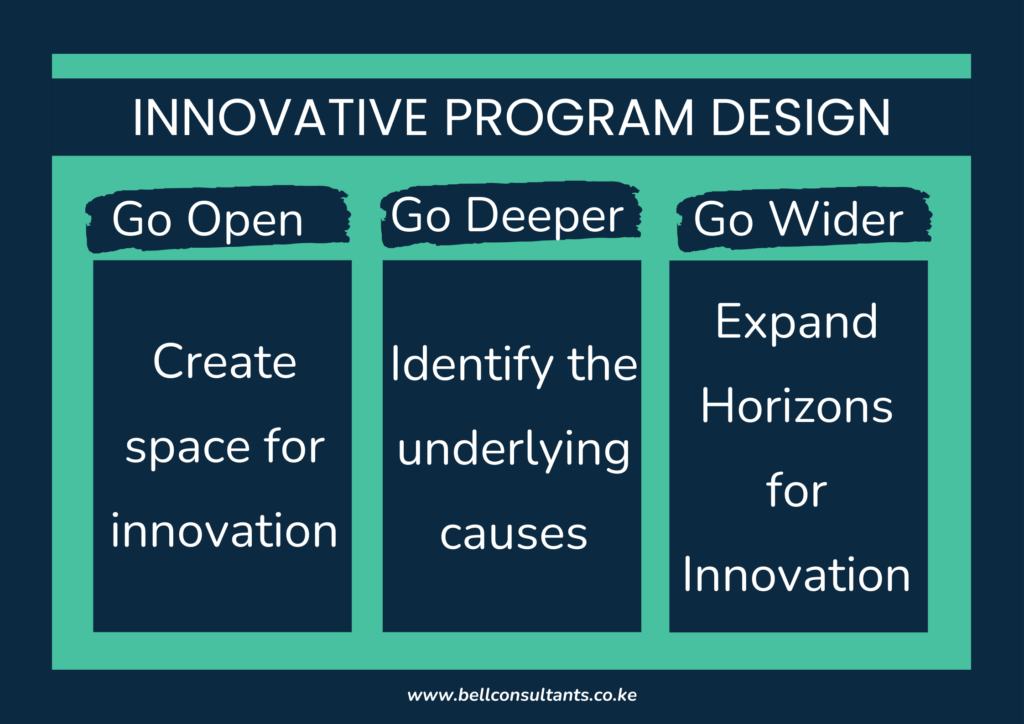
1. Go Open: Creating Space for Innovation
Innovation flourishes when organizations create an environment where new ideas are welcomed and tested. To foster this culture:
- Educate Funders: Help donors understand the importance of funding innovation by sharing success stories and demonstrating impact.
- Negotiate Resources: Advocate for financial support dedicated to piloting new ideas and projects.
- Encourage Experimentation: Empower staff, volunteers, and community members to propose and test ideas, recognizing that failure is part of learning.
2. Go Deeper: Identifying Root Causes
Innovation isn’t just about surface-level improvements—it requires a deep understanding of the issues being addressed. Root Cause Analysis (RCA) helps nonprofits identify the fundamental causes of challenges and develop targeted solutions.
- Analyze Problems Thoroughly: Use structured methods such as the “5 Whys” technique or Fishbone Diagrams to uncover root causes.
- Focus on Continuous Learning: Encourage teams to learn from both successes and failures to refine their programs.
- Allocate Resources Strategically: Direct efforts toward solutions that tackle the core of the problem rather than just its symptoms.
3. Go Wider: Learning from Other Sectors
Nonprofits don’t have to innovate in isolation—valuable insights can be gained by studying solutions from other industries.
- Explore Other Fields: Examine how healthcare, education, and technology sectors solve problems and consider adapting those approaches.
- Form Unusual Partnerships: Collaborate with businesses, universities, and other organizations to bring in fresh perspectives.
- Adapt Proven Models: Implement strategies that have been successful elsewhere, such as community mobilization efforts or task-shifting models.
Innovate and Elevate your Grant Fundraising with Bell Consultants.
Innovation is not just a buzzword—it is a necessity for nonprofits that want to maximize their impact. By creating space for new ideas, conducting deep analysis of problems, and learning from other sectors, nonprofits can remain adaptable and effective in their mission. Leadership plays a key role in fostering this culture by setting a vision, defining priorities, and modeling innovative behaviors.
Check out our premium training programs to gain the actionable strategies your nonprofit needs to secure funding. Our expert-led courses and specialized coaching will give you the skills to craft compelling proposals, build lasting donor relationships, and stand out in competitive funding opportunities.