 Skip to content

Making Smart Grant Decisions: A Go or No-Go Framework for Nonprofits
For many nonprofits, grant funding is essential, but deciding which grants to pursue can be overwhelming. Organizations are often tempted to apply for every opportunity that seems even somewhat relevant to their work.
But what’s the harm in applying for every grant?
Beyond being an inefficient use of time and effort, applying indiscriminately can actually harm a nonprofit’s reputation. It risks being seen as an organization that submits rushed or low-quality applications—or worse, one that applies for opportunities misaligned with its qualifications or mission. In the process, nonprofits may overlook key funding opportunities that are a better fit, ultimately limiting their impact.
So how can nonprofits make strategic “go or no-go” decisions when selecting grants?
Here’s a structured framework to guide the process.
1. Assess Strategic Fit
Before diving into application details, evaluate how well the grant aligns with your mission, programs, and long-term goals. Ask:
- Does this funding align with our core mission and strategic priorities?
- Will this grant support an existing program, or would it require launching a new initiative?
- Does the funder’s vision and approach align with ours?
If the grant does not strongly support your mission and strategy, it may not be worth pursuing.
2. Evaluate Eligibility & Requirements
Many organizations waste time analyzing grants they aren’t even eligible for. Before moving forward:
- Confirm you meet all eligibility criteria (e.g., nonprofit status, geographic focus, funding category).
- Review funder priorities and past grantees—does your organization fit their typical profile?
- Assess reporting, compliance, and administrative requirements—can your team realistically manage them?
If meeting these requirements would strain your resources, reconsider applying.
3. Consider Financial & Operational Capacity
Even if a grant aligns with your mission, consider whether you have the capacity to manage it effectively:
- Do we have the internal resources to manage, track, and report on the funds?
- Are there hidden costs, such as required matching funds or hiring new staff?
- Will this grant contribute to long-term financial sustainability or create dependency?
If the funding would create financial strain or require infrastructure you don’t have, it might not be the right fit.
4. Weigh Time Investment vs. Potential Reward
Grant applications can be resource-intensive. Before committing:
- Estimate the time and effort needed to prepare a competitive proposal.
- Consider the grant size—does the funding justify the application effort?
- Assess the likelihood of success based on competition and past funding trends.
If the time investment outweighs the potential benefits, it may be better to focus on more promising opportunities.
5. Ensure You Can Submit a High-Quality Proposal
Even if a grant is a great fit, ask yourself:
- Do we have enough time and resources to prepare a strong application?
- Can we develop a well-thought-out, compelling proposal by the deadline?
Remember, a weak proposal can do more harm than good. In many cases, no submission is better than a poor-quality one.
6. Gauge Relationship & Fundability
Funders are more likely to award grants to organizations they recognize and trust. Consider:
- Have we engaged with this funder before?
- Do we have a connection to the funding organization or an opportunity to build one?
- Can we strengthen our positioning before applying?
If your organization has no prior relationship with the funder, consider outreach before applying. Building relationships in advance can significantly improve success rates.
Competitive vs. Non-Competitive Fundraising Approaches
Grant seekers often grapple with the challenge of deciding how to split time and effort between competitive and non-competitive approaches.
Each approach comes with its own set of advantages and considerations.
Competitive Grant Fundraising:
- Involves nonprofit organizations vying with others for a finite pool of funds.
- Nonprofits typically wait for an open request for proposal (RFP) then prepare a detailed proposal.
- Then the potential funder undertakes a thorough selection process based on their set criteria.
Considerations for Competitive Grant Fundraising:
- Opportunities with larger sums of money
- Enhanced visibility by successfully securing a competitive grant
- The competitive process fosters accountability and transparency
- Intensive application process demanding significant time, resources, & expertise
- Uncertainty of outcome regardless of your level of preparation
- Limited funding pool means not all deserving projects will receive funding
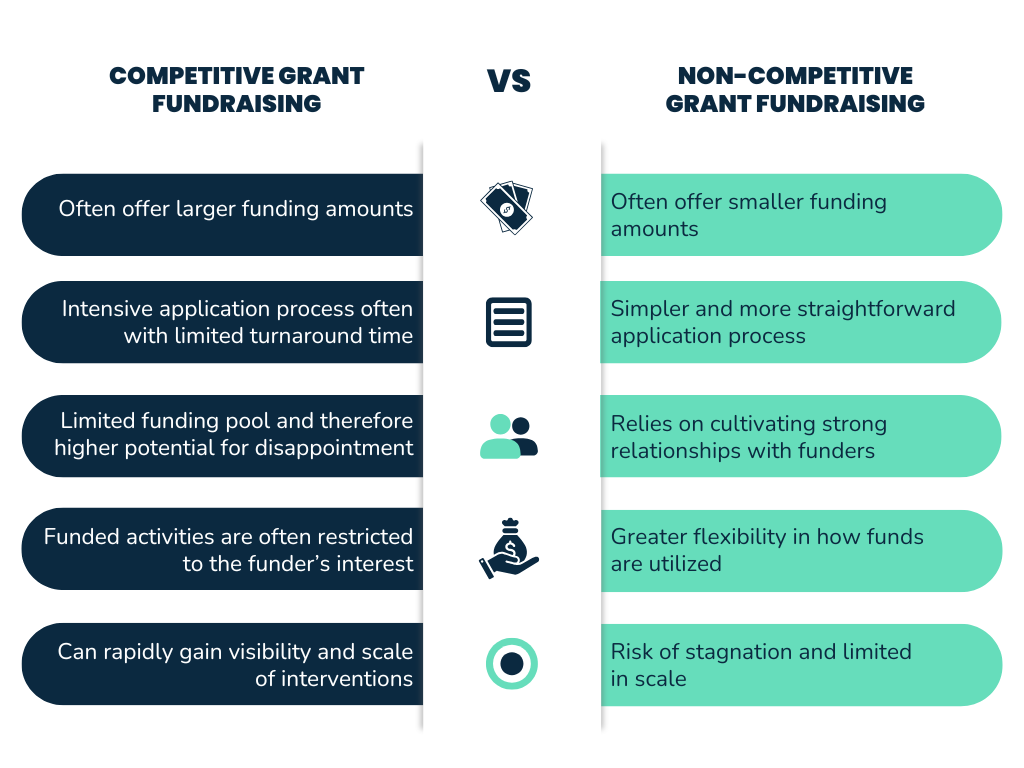
Non-Competitive Grant Fundraising:
- Involves organizations seeking grants from funders who don’t require an open and competitive application process.
- Grants are typically awarded based on established relationships, demonstrated need, or alignment with the grantmaker’s funding priorities.
Considerations for Non-Competitive Grant Fundraising:
- Streamlined process often involving a simpler application process
- Predictable funding providing stability for ongoing projects and operations.
- Flexibility and autonomy enabling quick responses to emerging needs and opportunities.
- Grantees may influence funders’ perspectives and direct where funds are invested, shaping donors’ priorities.
- Often offer smaller amounts compared to competitive grants, limiting project scale and scope.
- Dependency on relationships necessitating skill and effort in communication and stewardship.
- Reliance may lead to stagnation and stifling of innovation
- Relational nature of this approach may take time to yield results, requiring consistency, patience, and stamina.
Strategic Balance: Leveraging Both Approaches
Smart nonprofits strategically balance both approaches to diversify their funding sources and maximize opportunities. Here’s how:
- Diversify: Use both competitive and non-competitive grants to ensure a steady flow of funding.
- Maximize Opportunities: Leverage relationships and competitive grants to fund high-priority projects.
- Drive Mission Impact: Make decisions that align with your mission and sustainability goals.
By understanding when and how to pursue both competitive and non-competitive grants, you can better navigate the complex fundraising landscape.
Conclusion
Making smart grant decisions requires a thoughtful approach. By using a structured “go or no-go” framework, you can identify the grants that will best support your mission and long-term goals. Additionally, balancing competitive and non-competitive strategies will help you optimize funding sources and achieve greater impact.
Elevate your Grant Fundraising with Bell Consultants.
Check out our premium training programs to gain the actionable strategies your nonprofit needs to secure funding.
Our expert-led courses and specialized coaching will give you the skills to craft compelling proposals, build lasting donor relationships, and stand out in competitive funding opportunities.
